
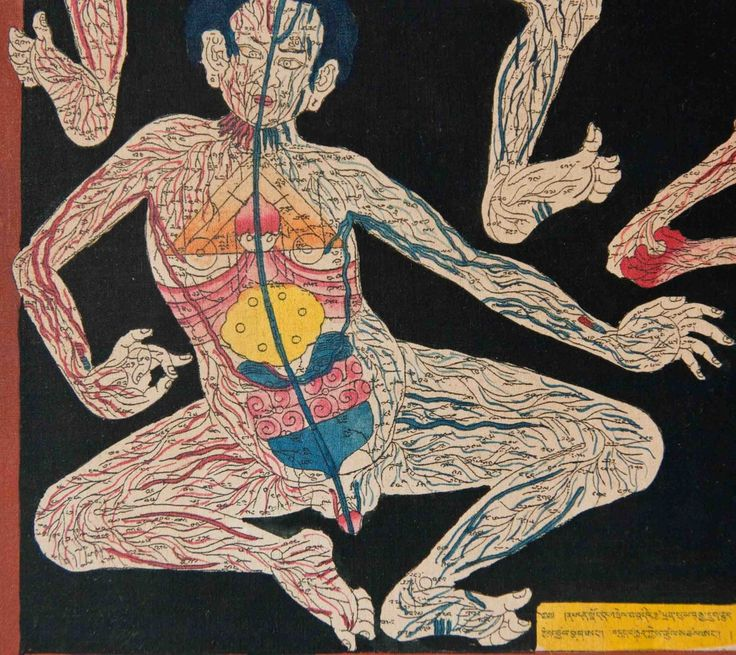
Our nervous system is your body’s command center. It’s made up of your brain, spinal cord and nerves. Your nervous system works by sending messages, or electrical signals, between your brain and all the other parts of your body. These signals tell you to breathe, move, speak and see, for example. Your nervous system keeps track of what’s going on inside and outside of your body and decides how to respond to any situation you’re in.
The nervous system decides how to respond to situations based on memory. The tangible impulse of these commands given by the nervous system manifests as electrical signals. In yoga, this energy or electricity is referred to as prana. Prana is in yogic thought a substance that is neither physical nor mental, but which forms the medium between them. It is – in yogic thought – the vehicle by which thoughts become matter, and matter becomes mind.
Simply put, the nervous system conducts messages between the brain – the body’s main processor – and the various parts of the body. This communication is two-ways. It includes the five senses. The information absorbed through the senses can through the lens of neurology and yogic science alike be seen as raw data: it is not meaningful in and of itself. It is our brain and rational mind that codes raw sensory information and labels it. Smells, forms, sounds and tastes do not in and of themselves contain information – they are neither good nor bad. The meaning attributed to sensory impressions is attributed to them by the brain, which processes and interprets sensory data. In this process of interpretation, the brain – due to past experience, performs a moral evaluation of what the senses perceive. This evaluation is in yogic science referred to as vedana. The word vedana can be translated as “coloring” or “toning”. It refers to how we habitually judge and evaluate certain impressions as good, and others as bad. This process is both internal and external, which means that we perform this judgment both on our own thoughts and feelings, and on the external world. This fast evaluation pulls heavily on memory stored mainly in the hippocampus and prefrontal cortex: If a situation resembles something dangerous from your past, the brain “tags” it as bad very quickly. If it resembles something rewarding or neutral, it tags it as good or safe. These two modes of neurological functionality are reflected in the story of the Buddha’s liberation, where he confronted Mara – the lord of illusion – under the bodhi tree. Mara’s two chief generals are raga and dvesha or aversion and attachment: spiritual reflections of the nervous system’s pull towards “good”, and push towards “bad”.
The brain and nervous system cooperate in this evaluation and in the response to it. They do this by quickly judging whether something is “good” – safe or rewarding – or “bad” – dangerous or threatening – often before you’re even conscious of it. This rapid, subconscious, memory-based valuation of reality on the basis of memory is the basis for what we label “personality”: the bundle of reactions, likes, dislikes, judgments, preferences and habits that forms our self-perceptions. In yogic science, these chain reactions of evaluations, responses and consequential behavioral patterns are referred to as samskaras, or cittam-vritti. The purpose of yoga is the untying of these neurological “knots”. In practice this translates into freedom from our past, habitual actions and the ability to perceive the world, others and the self clearly. The word clearly here refers to in-the-moment and uncoloured by past experience.
In order to understand yoga, it is paramount to understand that these evaluations conducted by the nervous system, and the resulting response by the body are reactive, instinctual and reflexive. There is no conscious actor that chooses how to respond. Neither is the brain the thinker of thoughts. In the modern world, many of us mistake the brain for a self-producing organ. Consciousness, however, is not produced in the brain. The brain is a pattern-recognizer. Its job is to ensure our survival. It does this by commanding us towards what it – on the basis memory and past experience – perceives as good or safe – and away from what is perceived as bad or dangerous. This process, if not regulated, keeps us in a constant prison of the past. Our current behavior is modelled after past perceptions of safe-unsafe, and we exist throughout a largely unconscious cycle of reactive behaviour. This is the true meaning of the Indic concept of karma. Karma is not a lofty, spiritual idea. It describes the very concrete way in which the mind remains imprisoned and suffering recycled by the patterned repetition of reactions produced by and sustained by the mechanisms of mind, brain, nervous system and body.
This connection is the basis of hatha-yoga, the most elegant, refined and effective somatic science in the world. Yoga is based on a sublime understanding of the mechanisms of the physical body, and how states of consciousness and physical responses are two polarities of a whole.
Given that our current samskaras, our karma, is an expression of the repetition of past experience in a mechanical way – we can establish new samskaras based on our current experience. In Indic thought, neuroplasticity, or the brain’s ability to change and adapt, and in consequence, the potential for radically changing who we are, our experience of life and how we engage with others, have always been taken for a fact. Yogic science does not take a big interest in “personality”, which is seen as a mere reflex – a survival strategy, more precisely – to past experience.
The reversal of this process occurs through working with the body – and the tensions, reflexes and patterns stored in it – through the present moment. Through a multitude of yogic technologies – our current experience is altered – and we move beyond the bondage of karma and our perception of good and bad. The body is brought to a state of balance and the flow of prana, or electric nervous signals, is halted. This state of neutrality – or a neurological tabula rasa – is then used to establish new experiences and patterns, according to the intentions of the yogi in question. All positions in hatha-yoga has a direct effect on the function of our nervous system, and as such our perception of reality. The claim that yoga and meditation has the power to alter reality is thus not a lofty, unfounded claim, but the concrete and natural result of the mechanisms of our nature.
As an example, yogic science claims that stability of posture equals stability of mind, and that the main conductor of prana, or vital energy in the body is the shushumna-nadi – located in the spinal cord. In yogic science – this energy-channel is the seat of consciousness, and the mediator between spirit and mind. In modern neurology, this is echoed in the spine’s role as being the primary conveyor of signals between brain and body.
Now, posture and brain health are intimately connected through the mechanics of the spine: and a correct processing of sensory input – or a correct, open and balanced interpretation of reality – is a function of a regulated, healthy brain. Within the spine, there exists a fluid which in modern science is referred to as the cerebro-spinal fluid. Yogic science refers to it as bindu. This fluid is produced by the choroid plexus in the brain – or what yoga refers to as the ajna-chakra. The word ajna in Sanskrit – interestingly enough – means to command, which underlines the brain’s executive function over the nervous system as its command centre. One of the many functions of this fluid is the delivery of nutrients to the brain – in addition to the removal of waste, which is critical to neural function. The flow of this fluid is again dependent on spinal alignment, which refers to the straightness and freeness of the spine – one of the core aims of yoga – which refers to the flexibility and strength of the spinal cord as the pillar of spiritual and physical health. Impaired flow of cerebrospinal might also over time lead to neurodegenerative diseases – such as Alzheimer’s or Parkinson’s – which can be seen as conditions opposite to a nervous system in full plasticity. Additionally – proper posture and spinal health regulates the flow of electric signals between body and brain, which is, in neurological language is saying the same exact same thing as yoga-shastra says when describing the importance of a straight and pliant shushumna-nadi for the healthy flow of prana between the our spiritual and material selves.